

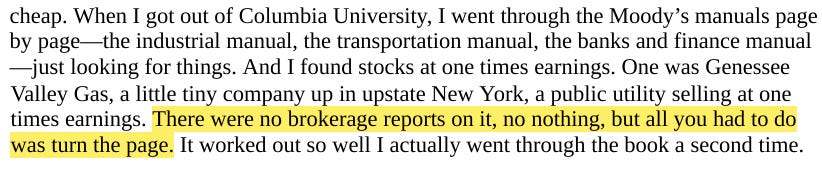
“All you had to do was turn the page.”
That’s how Buffett described finding bargains in the Moody’s manuals.
And he turned a lot of pages.
On page 1433, he found Western Insurance trading at $3 while it was earning $20 a share. Ten pages later, on page 1443, he found National American Fire Insurance, trading at $27 while it earned $29.
Nobody told him about these ideas.
There was no friendly broker or analyst who flagged this to him.
He had to go find it himself.
It’s really not that different today. You just don’t have to flip through a five pound book anymore, instead it’s clicking through every single ticker on a given exchange.
That’s how I found today’s stock. It was hiding among the smallest companies in Singapore.
It has virtually no analyst coverage, and trades at 5x earnings and 77% of NCAV.
The company repaid all bank debt, and paid their first dividend in 2025.
Insider ownership is high, and the CEO has repeatedly been buying shares in the open market.
But it’s tiny, illiquid, and unknown.
That’s why it’s cheap.
Enjoy.
TSH Corporation Limited ($KUH)
Market cap: S$6.39mm / US$5.02mm
One word: Whisky.
TSH doesn’t distill it themselves, but they pour it.
Among other things, through the six bars they run in various Singaporean hotels.
But they also import and distribute premium whisky, and buy whole casks to bottle under their own labels.
The bars are all different. Not one is like the other.
The reason is simply the size of the country.
Singapore just isn’t big enough to open ten bars that all look the same. You’d end up competing with yourself.
That’s why one bar is a vintage style whisky bar with tastings and masterclasses, another serves fine whisky paired with seafood and high end tasting sets, and yet another mixes cocktails into the offering.
The importing segment is where the company started.
The goal was to bring single malt scotch from the UK to Singapore.
Today they import more than 20 brands from boutique distilleries, among others from Scotland, Ireland, and South Africa. Worth highlighting are the exclusive Singapore rights they hold for a number of them.
Some of the bottles get sold on a wholesale basis to other bars, hotels, clubs, or private customers. This part carries weaker margins than the rest.
The better margins come from casks.
Since 2017, TSH has bought whole casks of old maturing whisky and bottles them under its own labels.
At the end of 2021 they held more than 30 casks in inventory. (That’s the most recent number they’ve disclosed.)
Another ~3% of revenue comes from a whisky fair they organize. They call it “Whisky Journey.”
It’s actually Singapore’s largest whisky fair, and it keeps getting bigger every year.
The 3% of revenue is nominally pretty insignificant, but the effect of the fair isn’t.
It’s good for the brand.
It brings distilleries from all over the world to Singapore, and TSH stays in everyone’s memory as the organizer.
The Moat Question
Anyone can open a whisky bar in Singapore, and many have.
Still, TSH has two things that look moat like.
The first, like with many small businesses, is the name and the relationships.
They have 20 years of relationships with Scottish distilleries, and exclusive Singapore rights for more than 20 brands. That’s the strongest moat like element.
The FY21 report itself states: “direct importation rights from distilleries and bottlers in Scotland are highly sought after.”
Their own name should carry some weight with local connoisseurs too, a name reinforced by masterclasses and special events. The fair does the same job on the distillery side.
The other element is the cask inventory. Casks and rare bottles bought years ago at lower prices. No new competitor can go buy Bunnahabhain casks at 2017 prices.
Backstory
Two people built this business.
The entrepreneurial couple Chua Khoon Hui and his wife Ng Pei Wah.
Chua Khoon Hui has a background in auditing. He trained as an accountant and started his career at KPMG.
Between 2002 and 2005, he and his wife dabbled in a few food and beverage businesses, learning as they went.
Then, at the end of 2005, came the decisive move, and Chua founded The Whisky Store.
In 2007, the first Quaich Bar opened at Waterfront Plaza, Singapore’s first dedicated whisky bar.
More bars followed over the years, and the entities were eventually grouped under one holding company.
By late 2018, they wanted to take it public.
That’s where one person played a key role.
Teo Kok Woon.
Teo is a hotelier from a Singapore family with hotel and property interests.
He’d already played a key role funding and growing the whisky group, back when it was still called “Sloshed!” By 2018 he held 77.3% of it, versus 20.1% for Chua.
Beyond his equity stake, he’d also given the group an interest free loan in 2018, which he later forgave.
As it turned out, Teo also owned 28% of an empty, listed cash shell. And that shell became the vehicle.
Through a reverse takeover, the whisky business went public, kept the shell’s name, and became TSH Corporation Limited.
The Numbers
Official filings start with the 2019 annual report, though we have older numbers from the RTO circular.
The 2017-2019 numbers show a small, very profitable business, with 2018 affected by the opening of two new outlets and listing costs.
2020 was a disaster.
Bars shut for months, revenue dropped 46.8%, and the company posted a loss.
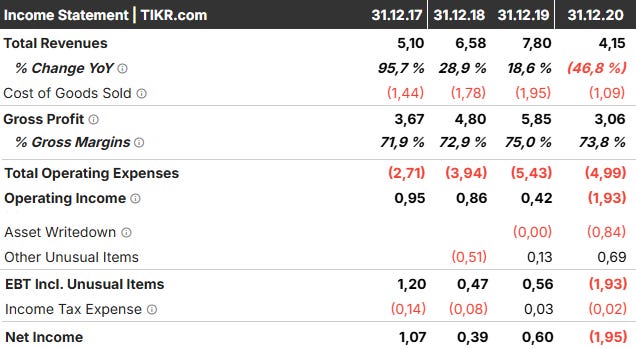
I want to point out that management didn’t lay anyone off, and didn’t cut pay for most of the staff either, apart from a few who volunteered for pay cuts, along with independent directors who gave up part of their own fees.
TSH used the downtime to buy more old whisky casks. In 2021 they drew a S$2.5m bank loan to buy even more.
In 2022 the bars reopened fully, three new outlets were added, and revenue has grown every year since.
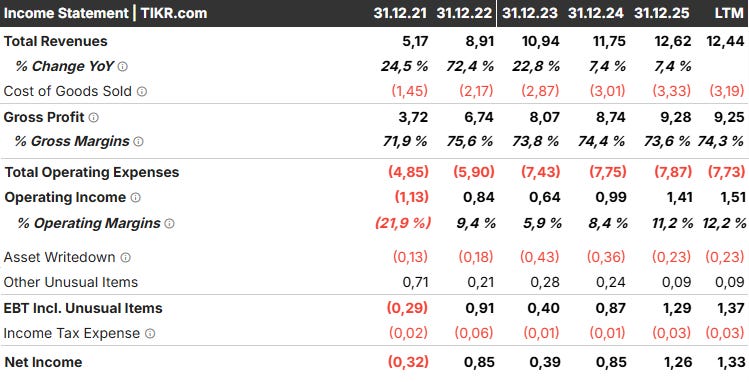
The growth came from three sources.
First, the reopening released two years of pent up demand.
Then, the new outlets that were opened. The 22.8% growth in 2023 is mostly attributable to those.
And from 2023 onwards, sales of limited and own labelled whisky started growing too. That’s the cask strategy paying off.
The 7.4% growth in both 2024 and 2025 came with no new outlets, so it’s pure like for like growth from higher outlet sales and bottlings.
Gross margin stayed stable in the 72%-76% band, even through Covid and expansion.
Operating margin is a different story.
It moves with outlet count, wages, and rent.
A few percentage points of revenue change, on top of a high fixed cost base, have a big effect on profit, in both directions. The 42.6% growth in operating profit in 2025, against just 7.4% revenue growth, shows that well.
Balance Sheet
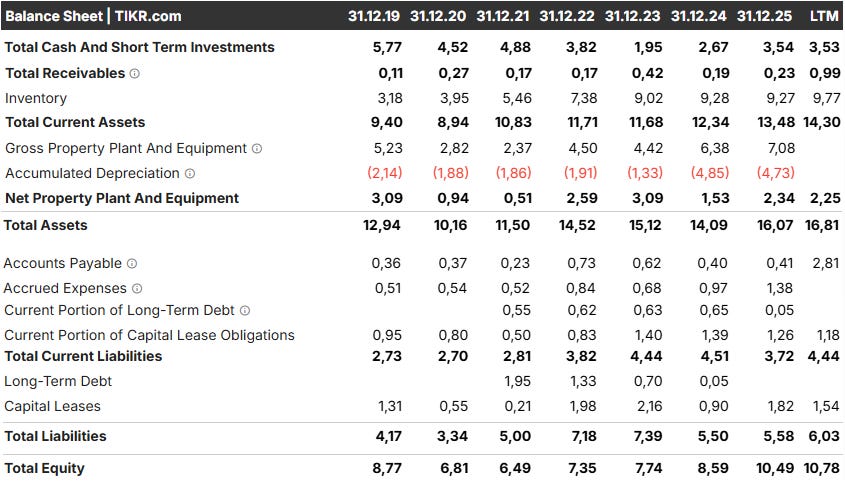
The balance sheet basically tells the story of a swap of cash for whisky.
They started 2019 with S$5.8m of cash (mostly left over from the shell) and S$3.2m of inventory.
By the end of 2023 they had S$1.9m of cash and S$9m of inventory, with S$1.33m of bank debt on top.
Since then the company has stopped adding to inventory, repaid the debt, and rebuilt cash to S$3.53m.
The inventory of S$9.77m is the main part of the balance sheet. It’s also the most important part of the business, since it feeds every segment. Still, it makes up 58% of total assets, and about 1.5 times the market cap.
On a normal, unadjusted net-net calculation, the business trades at 77% of NCAV.
S$6.39mm / (S$14.3mm - S$6.03mm) = 0.773
Graham sometimes took inventories at 50%-75% of book value, to get closer to a fair or fire sale value. That makes sense for most businesses.
Not here, I’d argue.
Because in this case, the inventory is whisky casks and bottled whisky.
Aged whisky tends to get more valuable with time, not less.
The auditors test the inventory every year too, and there have been no impairments, since the value of the whisky holdings has stayed above cost.
Which makes sense, since most of it was built up between 2017 and 2021, before whisky prices peaked. (And yes, prices have dropped again since. Management reacted accordingly, more on that further below.)

There is a small impairment line on the income statement since 2020, but it has nothing to do with the whisky itself. It’s the writedown of lease assets for outlets that aren’t earning back their rent.
In the 2021 annual report, they even describe whisky as an alternative asset class, and quote Knight Frank on rare whisky beating every other luxury asset over a decade.

Management & Capital Allocation
I like the behavior of management.
I think they did a lot of things right. Maybe that’s the auditing background of Chua Khoon Hui coming through.
Here are a few things worth pointing out:
They haven’t raised any equity, or diluted shareholders (a small additional point on this further below.)
They grew their outlet count without any real debt financing, and closed underperforming stores fairly quickly.
They’re good to their employees (no layoffs during Covid, no broad pay cuts.)
They used the Covid “break” to start the whisky event Whisky Journey, and to build out inventory for the future.
The bank loan they drew to buy more casks got repaid consistently, and only once it was fully repaid did they start paying a dividend.
They scaled back cask purchases as the market peaked.
To me, this behavior reflects long term thinking and restraint, without any need for fast, aggressive, leverage fueled growth.
I’d guess the absence of a buyback simply comes down to the low 21% free float.
Management commentary in the annual reports is also always formal and honest. The 2021 report was probably the most promotional, with that Knight Frank quote.
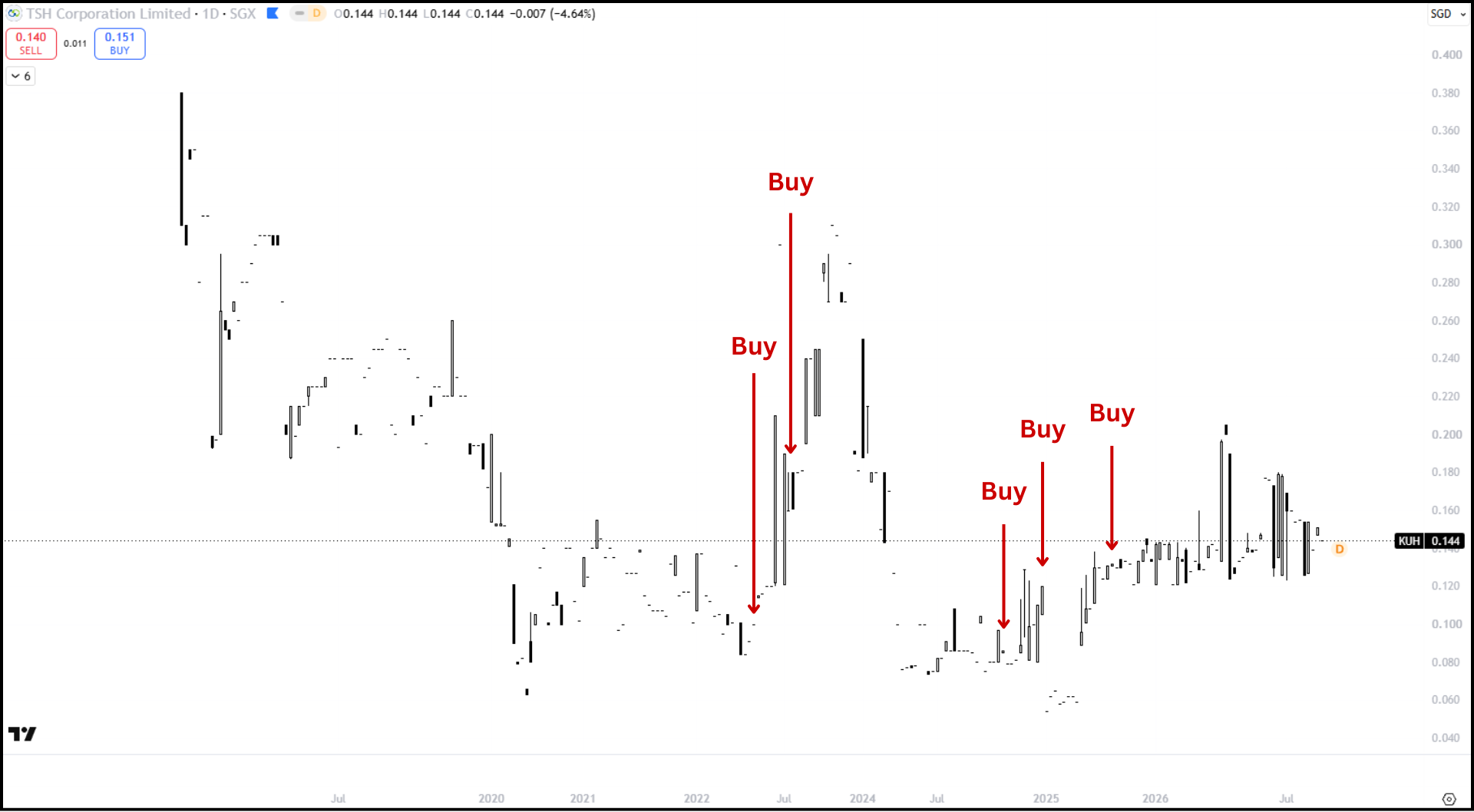
Also interesting are the CEO’s open market buys over the last few years.
He’s repeatedly bought in the price range of S$0.08 to S$0.17, with the last buy on September 12, 2025, for S$7,207 total.
You can see where he bought in this VERY liquid chart below.
His pay is really the only weak spot here.
He received S$382k in FY2025. His wife, the operations director, earned S$200k-250k. Total key management pay was S$973k in FY2025, equal to 73% of net profit and about 16% of the market cap. Not nothing.
The contrast to Teo, the majority shareholder, is stark. He takes nothing. He only gets paid through the dividend.
Teo really is the key man here. Which also makes him the key risk.
Everything in the records points to him being a patient financial backer who lets the founders run the business. He takes no fee or salary, forgave a S$637k loan, and has never extracted anything. And yet, as a 64% holder, he can pass any ordinary resolution alone, block anything, and if he ever needs cash, that block could be sold.
Valuation
The stock is dirt cheap.
It trades at 4.8x earnings and 77% of NCAV.
Here’s a full valuation snapshot.
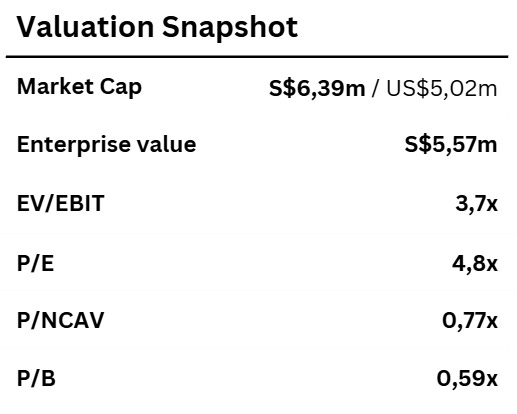
Gross margin is very stable. Earnings less so, given the nature of a fixed cost base business. Still, S$1.2m to S$1.4m in earnings before tax looks like a normal year.
What makes me comfortable is the downside protection from the asset side.
The main reason the stock is so cheap is that it’s a S$6m company with a S$1.3m float, and virtually no coverage.
It’s simply invisible.
Acquisition
TSH just made its first acquisition, and I think it was a smart one.
In August 2026, TSH bought the assets of The Auld Alliance, another whisky bar in Singapore.
The total price was S$1.98m.
Here’s how it splits up:
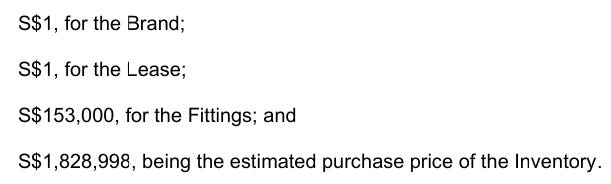
They paid one dollar for the brand and one dollar for the lease. That’s good.
The bulk of the money went toward whisky and furniture, so no goodwill lands on the balance sheet.
The payment was made via S$500,000 in new shares, and the rest, S$1.48m, in cash.
The Auld Alliance was founded by Emmanuel Dron, a Frenchman, in 2010.
While TSH plays in boutique distilleries and 20 to 30 year old casks, Auld Alliance plays in more vintage rarities.
It’s an approach not yet represented in TSH’s portfolio.
They offer rare and very old whisky by the glass, making these bottles accessible to enthusiasts who might otherwise never be able to afford a full bottle.
They carry an inventory of over 1,500 whiskies, with some vintage bottlings going back to the 1860s.
The address is especially worth highlighting here.
The Auld Alliance sits at 15 Stamford Road, #01-62.
TSH’s Capitol Cigar & Whisky Lounge sits at 15 Stamford Road, #01-60/61.
So they’re direct next door neighbors, even sitting in the same building.
This is the building, and where the two bars sit:
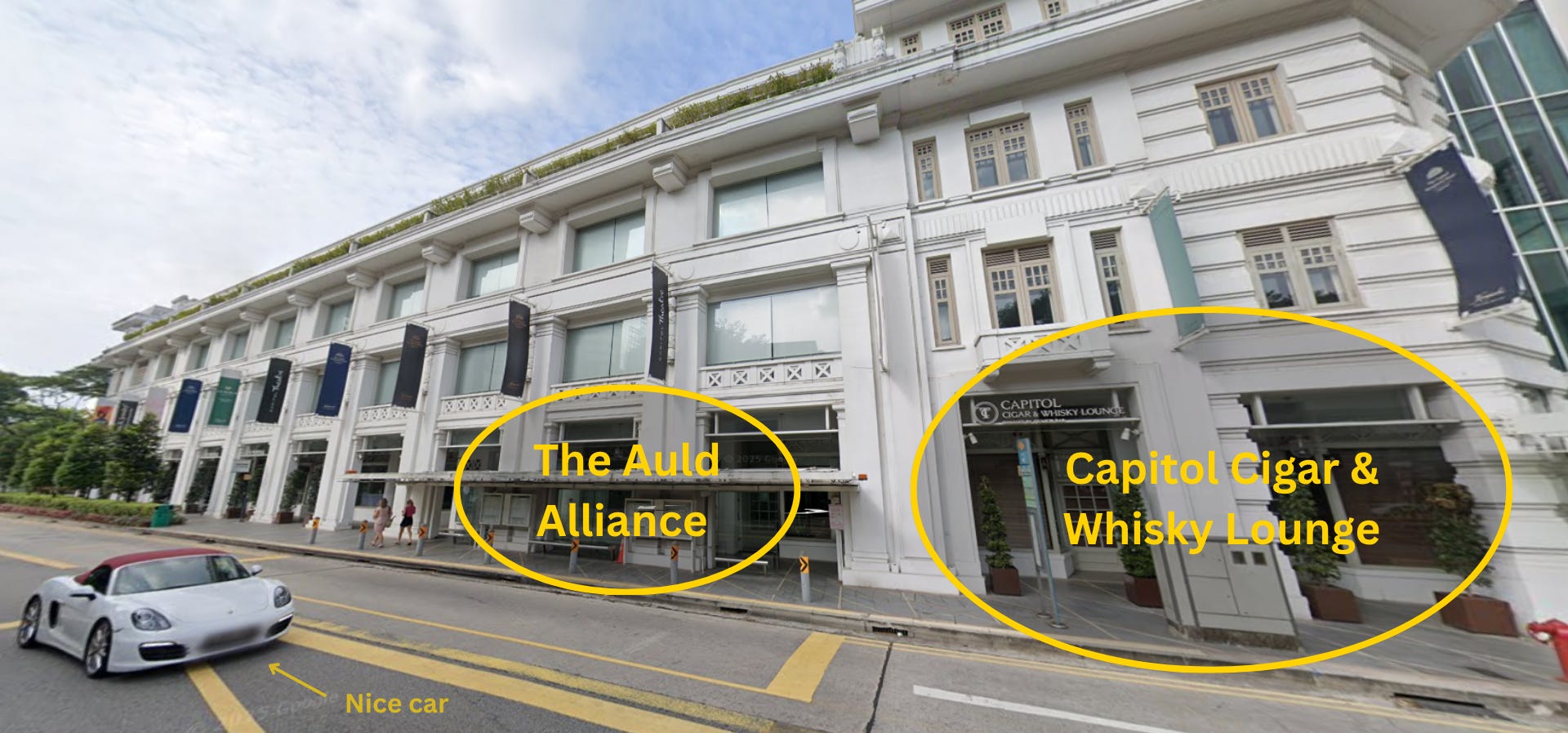
They didn’t mention this in the announcement. There they only speak of a “strategic opportunity.” I guess this explains it.
This is also the first time they’ve issued new shares since the listing.
They issued 2,083,333 new shares, 4.7% of the share count.
But the shares were issued at an 88% premium. While the stock was trading at S$0.1275, new shares were issued at S$0.24.
In the announcement they said the price was set “taking into account the net asset value of each Share,” and net asset value per share was S$0.243 in June.
It was also negotiated that the vendor can’t sell for three years, on a staggered basis. On top of that, Emmanuel signed a service agreement to introduce suppliers and customers, advise on procurement and distribution, train TSH staff, and offer TSH any opportunity he comes across. He also signed a non-compete.
All in all, this looks to me like a calculated acquisition, not a shareholder value destroying one chasing extraordinary growth.
Looking at the whisky price, the timing of the acquisition, or rather the timing of buying the assets and inventory, is interesting too.
The whisky price had fallen, and they used the opportunity to fill their inventory with niche vintage bottles. That shows the same purchase discipline we’ve already seen from them earlier.
On top of the stock, which they can likely sell at their 72%-76% margins, they also acquired the people who drank there.
Auld Alliance has a following of collectors, and management pointed out that the deal, among other things, aims to broaden the customer and supplier base and improve the product offering.
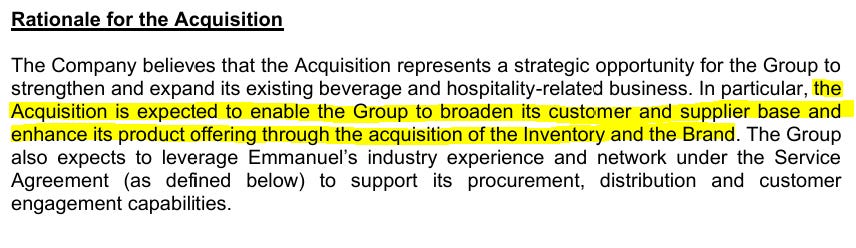
Not bad, for absorbing a direct competitor in the same move.
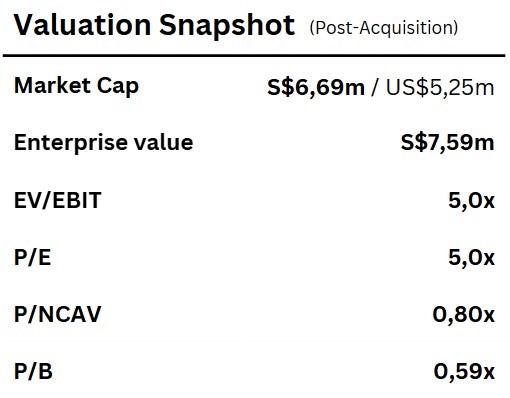
This is how the valuation should look now:
Final Thoughts
TSH is a simple and easy to understand business.
It’s profitable, has a strong balance sheet, and restrained, shareholder aligned owners.
The valuation is a fraction of what the earnings and the assets justify.
The only reason it’s this cheap is that it’s small, illiquid, and unknown.
A classic microcap setup that bigger guys can’t access.
Btw, here’s the full quote I was referencing at the beginning. It’s from the book “Tap Dancing to Work”:
Disclaimer: The information provided in this newsletter is intended for informational and educational purposes only. It does not constitute financial, investment, legal, or tax advice. All analyses, opinions, and interpretations reflect my personal views at the time of publication and are provided without reference to the individual circumstances or objectives of any reader. All analyses, information, and opinions have been prepared with great care. Nevertheless, no guarantee can be given as to the accuracy, completeness, or timeliness of the information provided. Use of the content is at the user’s own risk. Investing in securities involves risk, including the possible loss of capital. Readers should conduct their own research and, if necessary, consult a qualified professional before making investment decisions.