

Key Metrics:
Market cap: £9.2m
~7x earnings, ~5x forward earnings
Core business has grown 15% a year for 5 years
Just landed its biggest order ever
For the past few months, I’ve been digging through the OTC, the TSX/TSXV, Singapore and most of Europe.
I was looking for the best opportunity to put my money into (you’d laugh at the amount), and I was not going to settle for something mediocre.
So I looked hard.
There were lots of okay-ish opportunities. A couple of stocks had government tailwinds. Some had undervalued real estate (but how do you unlock that if it’s not for sale?). One stock was even being liquidated and traded at half its net cash, but I couldn’t tell if the money would come back in one year or in three.
None of it really convinced me. I was looking for something you’d look at and immediately think “yes, that’s something I want to put my money into”, or at least something where the idea was obvious.
Eventually I found something.
A small company hidden on the AIM.
They have a really solid and growing main segment.
Unfortunately (or fortunately?), they also had two other, rather bad, segments that drowned out the numbers of the good business.
Management has noticed this too and started selling the bad segments to focus fully on the good part. That part has grown by 15% a year for the past 5 years, and the company just landed the biggest order in its history.
With the weak segments gone, the stock now trades at 7 times earnings, and (by my math) at about 5 times forward earnings.
Here is the company:
Newmark Security plc
Market cap: £9.2m Ticker: NWT
Newmark is a small company from the UK.
The core of it is Grosvenor Technology (GT). GT builds time clocks, the terminals companies hang on the wall so employees can clock in.
Working hours are then tracked down to the minute. (An upside or a downside, depending on how you look at it.)
GT offers different models. There are cheap entry-level devices where you just clock in with a card or a PIN, and premium models for big warehouses with face recognition, which stops a colleague from clocking in for you.
For the time tracking to work, you also need the right software. That software usually comes from a different company.
There are two kinds of software providers in this market.
Some software companies have their own clocks, and some are pure software companies without one.
The ones with their own clocks don’t need GT, so they are not customers.
The ones without their own clocks are the interesting ones. GT partners with them and supplies the hardware. Examples of such companies are Paycor, ADP/WorkForce Software, Legion, Protime, Workday, Oracle and SAP.
When a company needs time tracking software, it usually buys it from a provider like Paycor. Paycor then offers a time clock on top, often under the Paycor name, but built by GT.
GT ships the clock directly to the customer and sends the invoice to Paycor.
On top of that time tracking software, every GT device also runs GT’s own software. It keeps all the clocks running and lets you manage the devices remotely.
Paycor can see all of its customers’ clocks in one dashboard, notice right away when one is offline or broken, and push updates.
This gives GT two revenue streams for every clock sold. One is the upfront revenue (the bigger part), and the other is a monthly fee for the software.
A fairly new product is their app “GT Tablet”. It turns a normal tablet into a time clock with face recognition.
It can do less than a real GT clock, but it’s flexible. It’s meant for places where you can’t hang a clock on the wall, like construction sites or pop-up stores. I’ll come back to why this part matters later.
Today the company is a lean business focused purely on time clocks, but that was not the case until recently.
On 30 September 2026, a segment called Safetell was sold. Among other things, it made bullet-resistant glass screens and secure counters for banks.
It was a project business with low margins and had little to do with time clocks. I think it’s good that this segment is gone, even though the terms of the sale could really have been better.
The GT business is currently still split into two parts. One is “HCM”, which is the time clocks we just talked about. The other is “Access Control”, a system that decides which doors in a building can be opened with an ID card. This part is being actively sold right now.

Once Access Control is sold, what’s left is a leaner company that is fully focused on time clocks.
The thesis, at its core, is that the other segments overshadowed the numbers of HCM. Because of that, few people noticed how well this segment has performed and how cheap the company actually is.
So let’s get to the numbers.
The Numbers
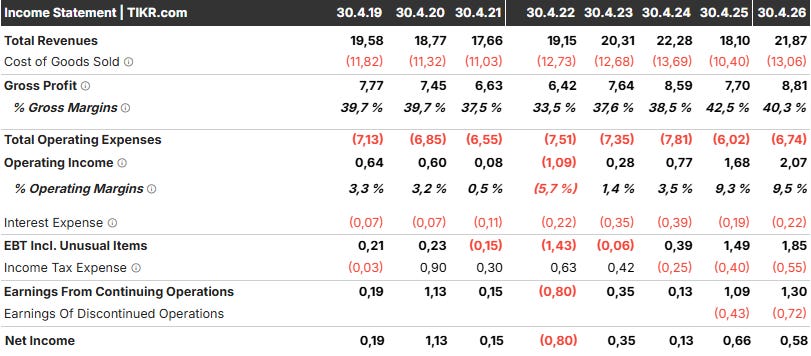
At first glance, the numbers of the last few years don’t look all that special.
You can see very little of the growth I described, let alone exceptional profitability.

But if we look at the HCM segment on its own, it looks a lot better:

This part has doubled in five years and has a CAGR of 15% over that time.
The recurring part is probably the most valuable one and has the highest margins. According to the trading update, it currently stands at £4.3m.
One case that is interesting, and important for later: In 2020, a large GT customer, Ultimate Software, merged with a company that makes its own clocks. Over time they realized they didn’t need GT anymore and pushed GT out completely by FY23.
This is one of the key risks that could happen here.
The Cleanup
Safetell lost £0.9m at the operating level last year and £0.75m the year before.
Access Control has been shrinking, from £3.0m of revenue in FY24 to £2.4m in FY26.
As said, Safetell was sold on 30 September 2026 to its own managing director for £1.
Newmark had guaranteed Safetell’s bank debt and had to settle about £2.1m of Safetell liabilities at closing. That means the debt stays on Newmark’s balance sheet.
Effectively, Newmark paid about £2m to get Safetell off its books. So the terms really could have been better…
But what can you do. At least the losses will stop.
TIKR actually already adjusts for this effect for the last two years, which is why the numbers look better there.
Access Control is being sold right now. Management says it is in talks with a potential buyer. At the AGM on 11 November, the chairman said the sale is expected to help reduce net debt, so they clearly expect a real price this time.

I do not know what that price will be, and Newmark has never disclosed what Access Control earns. My own back-of-the-envelope range is somewhere between a small loss and a profit of £0.5m.
For the sale, I think £0.5m to £1.5m is possible, but that is a guess.
For the modeling, I assume roughly breakeven, and I count nothing for the sale proceeds.
A word on the balance sheet:
Excluding leases, net debt was £4.8m at the end of April 2026, up from £2.1m a year earlier. The reasons were Safetell, a build-up of stock, and a lot of sales landing late in the year.
Since April, Safetell’s liabilities grew from £1.6m to £2.1m before the sale closed, according to the CFO. So I estimate net debt of about £5.3m.
If we add £0.9m of leases and the market cap of £9.2m, the enterprise value is roughly £15.3m.
Modeling
In FY26, the time clock business, GT (HCM plus Access Control), made £2.07m of operating profit and £1.3m of net profit, or 13.8p per share.
That puts the stock ~7 times earnings.
For FY27, the board has started “a thorough review of overheads, with a focus on central costs”, and the chairman is cutting his own pay by about half from 1 November.

So if we assume that Access Control is gone in FY27, that HCM does not grow at all, and that there are some head office savings, it should look somewhat like this:
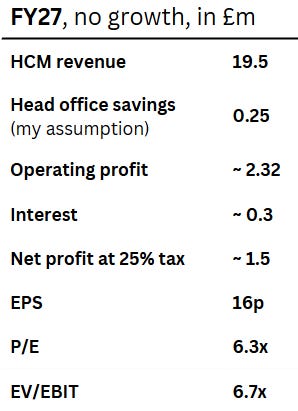
That puts the stock at a little over 6 times earnings, assuming no further growth.
But I do expect growth, and I’ll tell you why:
The largest order in the company’s history
On 2 November, the company gave a trading update. It said:
“Extended relationship with the Company’s largest HCM customer, securing a significant clock supply agreement which is expected to be delivered by the end of the financial year.”
The CEO called it “our largest clocks order ever with an existing key customer”.
But they gave no size and no name, just “largest HCM customer“.
I am fairly confident the customer is Paycor. Here is why:
In FY22, the annual report singled out Paycor as its “model partnership”.
The FY25 report names Paycor as a partner again.
Paycor sells an 8-inch face recognition clock under its own name that matches GT’s product GT8. The rest of the Paycor clock range also fits well with GT models.
But the most convincing part is this:
The FY26 report says GT Tablet is growing “with the support of our largest US partner”.
Paycor launched a tablet clock app called Paycor Time Mobile Clock in August 2025. That is the same half year in which GT says it launched GT Tablet.
Now take a look at the Android package ID of the Paycor app. That’s the end of this link:

I read “gtl” as Grosvenor Technology Ltd, which would mean GT built the app. And the ending “gtpaycor”, which really connects GT and Paycor, looks pretty clear to me.

None of this is confirmed by the company though.
This is a pretty good mitigation of one of the current main risks:
In April 2025, Paycor was bought by Paychex, a much larger payroll company that has sold time clocks itself in the past.
If Paychex now decides that Paycor customers should use Paychex clocks, GT could lose its biggest customer.
Similar to what happened with Ultimate Software in 2020.
But so far, everything I can find points in the opposite direction:
(1) GT’s largest customer grew 46% in the first full year under Paychex. And about 18 months after the takeover, that customer placed the largest order in GT’s history. I don’t think they’d place a record order with a supplier they are about to drop.
(2) Paycor also launched the new GT-built app four months after the Paychex takeover.
(3) The US customs records give the same picture. I checked the shipment records for a few companies on ImportYeti:
The most important one is probably Paychex Time & Attendance, Paychex’s own clock business. In 2015, it imported about 22 tonnes of goods by sea. Since 2021, it has been between 4 and 6 tonnes a year. In 2026 so far, there has been just one small shipment of 390 kg in February.
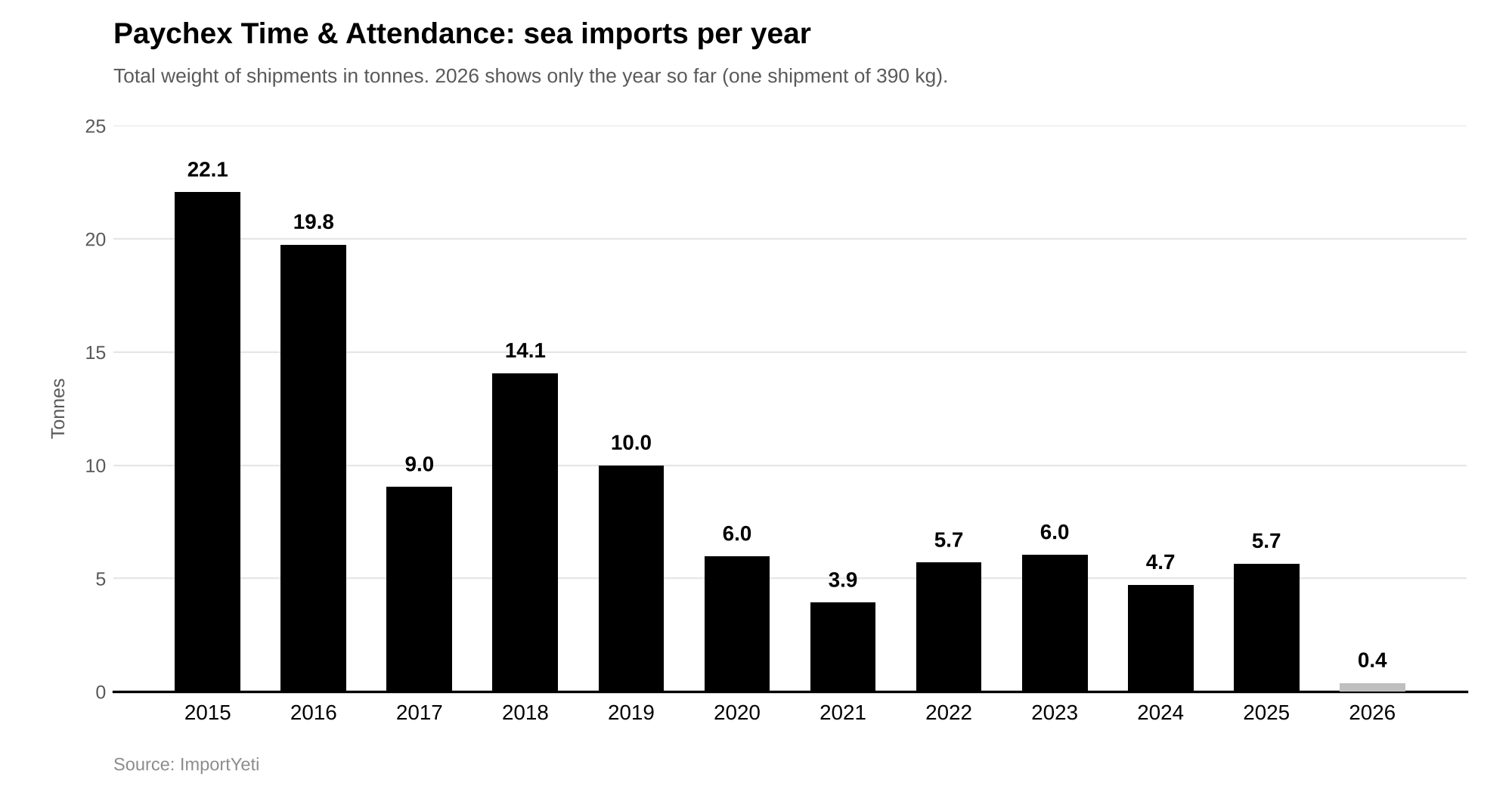
The Taiwanese company that made its older punch clocks last shipped in January 2022. A Hong Kong contract maker that built biometric clock parts for Paychex last shipped in 2019. The only regular shipments left are badge cards from a Taiwanese card maker and a few iris scanners from Korea. To me, that looks like Paychex keeping a small clock line of its own alive for existing customers, not building it up.
Paycor itself has no import records at all. That fits with GT importing the clocks and shipping them to Paycor customers on its behalf.
But it has to be said that this customs data only covers sea freight. Anything that comes by air is missing, and finished clocks may well fly.
Still, to me it doesn’t look like Paychex is about to throw GT out of Paycor. If anything, it looks like Paychex is relying on GT more.
One more side thought: if Paychex decided to use GT clocks across its own much larger customer base, that would have a huge effect on GT. But that’s really just a what-if scenario.
It also has to be said that the big order may have come with a price cut. Last year, GT’s gross margin fell by 2.2 points because of what it calls “strategic pricing initiatives with key HCM partners”. So I assume they won the big order through lower prices.
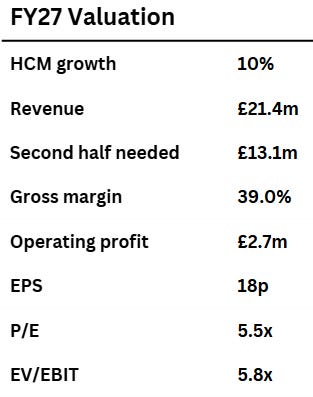
And the first half year was slow. HCM revenue for the six months to October was up only 5% to £8.3m. Management says this is in line with its plan and that the year is weighted to the second half, as it was last year.
For FY27, I expect roughly these results:
I don’t think the market has caught much wind of this yet. It is a small company, and its performance in the past was not visible at first glance.
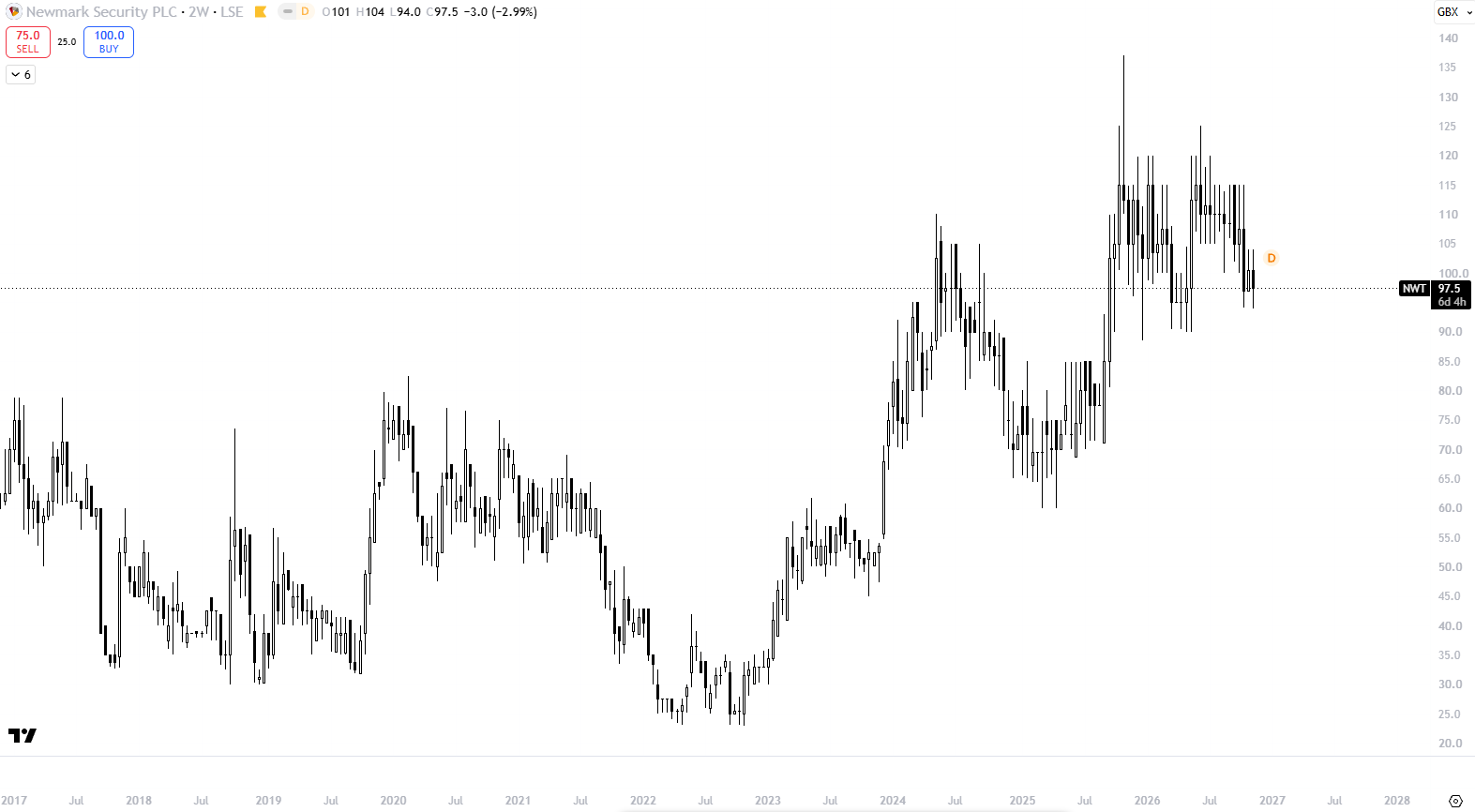
The stock is up 330% over the past 4 years, but it still trades near its 52-week low.
The largest shareholder is not happy
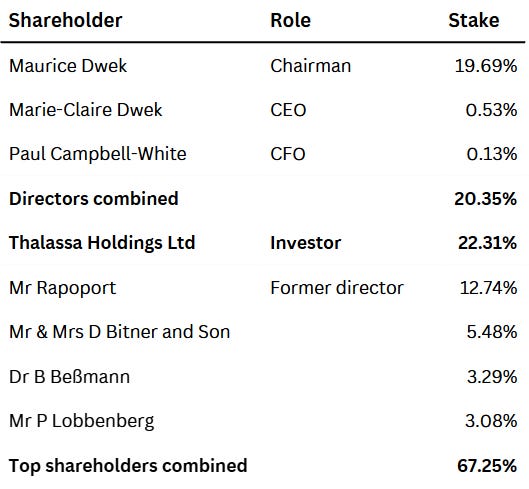
The company was floated in 1997 by Maurice Dwek, who is still the chairman. His daughter Marie-Claire Dwek has been CEO since 2013, and the family owns just under 20%.
Still, the family is not the biggest shareholder. That’s Thalassa Holdings, a small listed holding company run by Duncan Soukup. It has owned shares since 2019 and now holds a little over 22%.
He wasn’t necessarily happy about a few things. He wrote a rather blunt letter to the board in April 2025 and published a public letter in October 2025. You can read both here: https://thalassaholdings.com/investor-relations/reports-documents/
The first issue is pay. In his letter, he mentions that executives at the group and its subsidiaries were paid £7.8m between 2020 and 2025, while shareholders were left with £1.6m of net income over the same period.
Then there is the fact that bonuses were tied to revenue rather than to cash flow or returns on capital, which rewards size instead of results.
He also criticizes management for putting time and money into Safetell when the growth was clearly in the clock business.
I think he is right. In FY26, the board cost £891,000. That is close to 10% of the market cap and about one and a half times the group’s net profit of £0.58m (not adjusted for Safetell).
But I think it’s equally interesting what happened after the letters:
Two independent directors joined the board and one long-serving director left.
Safetell has been sold, although Soukup is right that the terms were poor.
Access Control is in a sale process.
At the AGM this week, the chairman said he is cutting his own pay by about half, that head office costs are under review, and that the bonus targets will be reset, with details promised in January.
I can’t tell if Thalassa made this happen. Either way, it’s the right direction.
And while the incentive structure could be better, this does not break the thesis for me.
Management is paid too much for a company of this size, and I would not buy the stock for the people at the top. But I also do not see a management that is ripping off shareholders and running the company purely for themselves.
The share count has barely moved in years, the weak first half was reported plainly, the loss-making segments are being sold, there was no acquisition mania to boost revenue, and the cost base is being looked at.
Key Risks
To bring them together in one place:
The two largest customers account for more than a third of clock revenue. I have explained why I think the largest of them is Paycor, and why the evidence so far points to a closer relationship rather than a weaker one. But the decision sits with Paychex, not with Newmark, and it can change. If Paychex one day standardizes on its own clocks, Newmark would lose a big chunk of its revenue.
Clock revenue grew only 5% in the first half, so my 10% for the full year depends on a strong second half and on the record order shipping before the end of April.
The January results will probably look a little ugly. The first half is always the weak half, and this time it will also include Safetell’s final losses and, I expect, a one-off book loss on the sale.
Final Thoughts
I think the thesis is pretty simple. The ugly segments are almost gone, so the full focus is now on the clock business. The near future looks fairly clear to me, and the business is cheap.
Management are not rock stars, but they’re not the reason I’m buying this stock. And it doesn’t hurt minority shareholders that the activist investor owns more shares than the family does.
I think the reason this opportunity exists is that the company is small and illiquid, and the good part of the business was not easy to see in the past.
So I’ve clocked in.
Disclosure: I own shares.
PS: The stock trading at half of its net cash that I mentioned at the beginning was the Italian company Autostrade Meridionali S.p.A. ($AUTME)
Disclaimer: The information provided in this newsletter is intended for informational and educational purposes only. It does not constitute financial, investment, legal, or tax advice. All analyses, opinions, and interpretations reflect my personal views at the time of publication and are provided without reference to the individual circumstances or objectives of any reader. All analyses, information, and opinions have been prepared with great care. Nevertheless, no guarantee can be given as to the accuracy, completeness, or timeliness of the information provided. Use of the content is at the user’s own risk. Investing in securities involves risk, including the possible loss of capital. Readers should conduct their own research and, if necessary, consult a qualified professional before making investment decisions.