

Key Metrics:
Market cap: $22m
4.7x EV/EBIT
8.2x earnings
No debt
I like to flip over rocks.
Not literally, obviously. But that’s part of the job, and that’s how you find new ideas.
The OTC is my favorite place for this.
There are always a handful of cheap stocks there.
You just have to go find them.
Today I want to show you one of them.
Table Trac.
On paper, it already looks cheap. But that’s not really the interesting part.
The real story, the shifting business dynamics that make this one attractive, doesn’t show up on a screen. You only see it once you actually sit with the business for a while.
And that’s what I want to walk you through today.
So stick with me, because this might be one of the most interesting setups on the OTC right now.
Table Trac (TBTC)
TBTC is a 32-person company out of Minnesota.
Their main product is a “casino management system” called CasinoTrac.
It’s installed in more than 300 casinos and helps them track their money flows.
More specifically, it connects to every slot machine and gaming table, records every transaction, runs the cage and the vault, and delivers business analytics plus the audit and accounting trail.
These casino management systems, or “CMS”, are not optional. Without a certified CMS, a licensed casino cannot legally operate.
And it’s not exactly a simple install either. In some cases they’re literally opening up the floor to run the cabling.
Table Trac earns money once, at every new installation, and afterwards through maintenance.
The maintenance revenue is the interesting part here. I’ll get into it in more detail in a bit. For now, just know that it grows with every new deal they sign.
It behaves a lot like SaaS revenue. Once it’s in, it barely costs anything to keep it running.
And once it’s in, it’s REALLY in.
Ripping out a CMS to save a bit on maintenance means tearing up the floor again, migrating the entire player database, retraining every department, and redoing a bunch of certifications.
Not exactly the natural first step when you’re looking to cut costs.
This makes the switching costs, in a way, the moat.
There are bigger competitors in this space too, but they fight over the bigger casinos.
TBTC’s customers, meanwhile, aren’t the glamorous Las Vegas resorts. They’re not run-down gas station casinos either. They are something in the middle.
A typical customer may be a tribal casino with a few hundred machines.
That niche is simply too small and unattractive for the bigger vendors. Their cost structure is built around enterprise accounts, and they can’t make money off a customer paying a few thousand dollars a month.
Table Trac can.
Not only that, but they apparently also undercut larger competitors by about 1/3 on price. At least that’s what I found in older analyses on TBTC. I couldn’t find any newer reports that confirm this, besides this interview where the CFO calls their competitors “insanely expensive.”
Besides the new installation revenue (they call it system sales) and maintenance revenue, there’s a smaller third line.
Service and other revenue.

This covers add-on products and services sold on top of the core system, things like kiosks, analytics tools, and extra equipment. They leverage their existing customer base and sell these products to them.
This line has grown a lot in recent years, but gross margins are lower here because there’s some hardware in it.
It’s not an uninteresting part of the business, but the thesis really centers on the rest of it.
About 94% of revenue comes from the United States.
Revenue
A typical new install seems to run somewhere between $300,000 and $500,000, depending on the size of the floor.
The system revenue line is lumpy, since it just depends on how many deals happen to close in a given year.
It swung from $6.3m in the record year 2022 to $2.9m in 2025, and back to $3.7m in the first half of 2026.
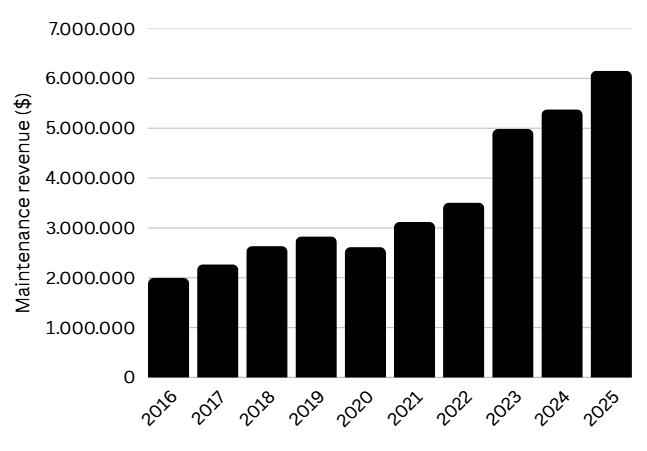
The maintenance revenue is a lot more linear.
Every system is sold with a monthly license and maintenance contract, with five years as the standard contract period.
Maintenance gross margins run at 79%. System sales are closer to 70%.
Because maintenance contracts renew, and new casinos keep getting added, this line has compounded almost without interruption. From $2m in 2016 to $6.2m in 2025.
In the 2019 annual report, the company disclosed that new contracts were expected to bring in $97,000 a month in recurring revenue on $4.46m of new contract value, about a quarter of the contract value on an annualized basis. But that figure probably overstates the real maintenance rate, since financing payments were mixed in there too.
Working backward from the current revenue numbers, with ~300 casinos, you get to $20k per casino per year. But this average is probably dragged down by decades of older, smaller, and cheaper installs.
My best guess is that annual maintenance fees run around 10-15% of the original system price.
And that brings us to the core of the thesis.
The Thesis
There are two buckets when it comes to Table Trac’s costs.
One is variable, the cost of goods sold, which just moves with however many new orders come in.
Then there’s a relatively stable block of fixed costs.
The SG&A, which includes R&D.
For most of its existence, recurring gross profit wasn’t enough to cover that fixed cost block. So TBTC’s annual profit basically came down to how many systems it installed that year.
And installs are won at trade shows, take months to close, and land unevenly.
So earnings whipsawed.
EPS was $0.07 in 2020 and $0.35 in 2022.
That picture might be changing.
In 2025, SG&A was $6.55m.
Maintenance contributed $4.87m of gross profit, and service & other added another $1.1m.
Together, that’s $5.96m of recurring or semi-recurring gross profit.
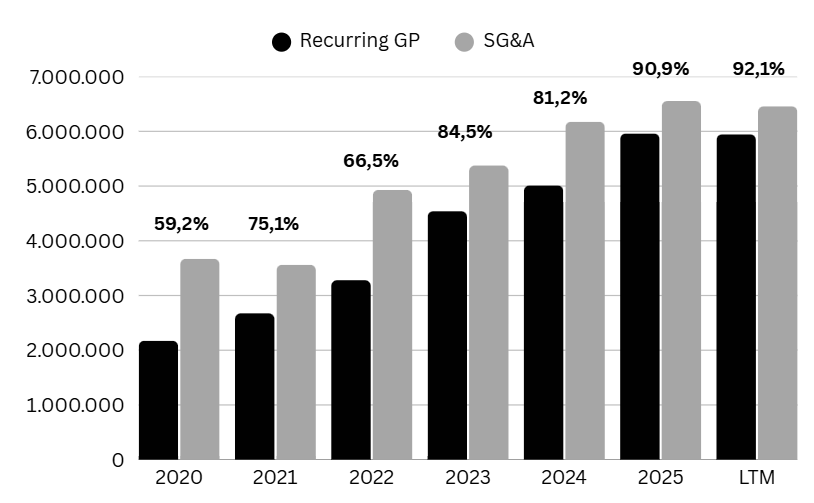
That covers 91% of the fixed cost block. On an LTM basis it’s 92%.
In 2020, it was 59%.
This chart shows the progression:
You can probably see where this is going.
The remaining gap between recurring gross profit and the fixed cost block is now down to about half a million dollars.
Once that gap closes, it changes the picture of this company enormously.
Up until now, system sales first had to fill that gap before any operating profit showed up at all.
Once the gap closes, recurring gross profit covers the fixed costs on its own, and the business is basically profitable by default.
Written as a formula, it looks something like this:
EBIT ≈ 0.7 × system revenue + (recurring gross profit − SG&A)
Right now, that second part of the formula is slightly negative. Once it hits zero, or turns positive, the gross profit from new system sales (which was still $2.2m even in the weak install year of 2025) starts falling almost directly through to operating income.
System sales will stay lumpy, that’s not going to change.
But from that point on, it’s not just that bad years no longer produce losses. In good years, with a lot of installs, profit explodes upward. And so does cash generation.
The gap might close faster than one might think, too.
In H1 2026, the company delivered nine new systems and three upgrades, recognizing $3.7m of system revenue.
Using the 10-15% rule of thumb from before, that alone should push annual maintenance revenue up by $370-550k. That could close the gap all by itself.
Then there’s the service segment, which adds another layer to this.
Service gross margin fell from 65% in H1 2025 to 46% in H1 2026, likely due to the kiosk hardware mix.
On the current service run-rate of about $2.7m a year, every ten points of margin is worth about $270,000 of gross profit. A reversion toward the 57-60% the segment achieved in 2025 adds $300,000 to $400,000 a year, without a single dollar of new revenue.
And then there’s the growth of the segment itself. After 51% growth in H1, even a slowdown to the average growth rate of recent years, around 20-25%, adds several hundred thousand dollars of gross profit within two or three years.
Valuation
2020 showed exactly how much support the maintenance revenue provides.
COVID cut the revenue in half, new installs were frozen, and the company slipped into an operating loss. But only a slight one, precisely because the maintenance revenue held up.
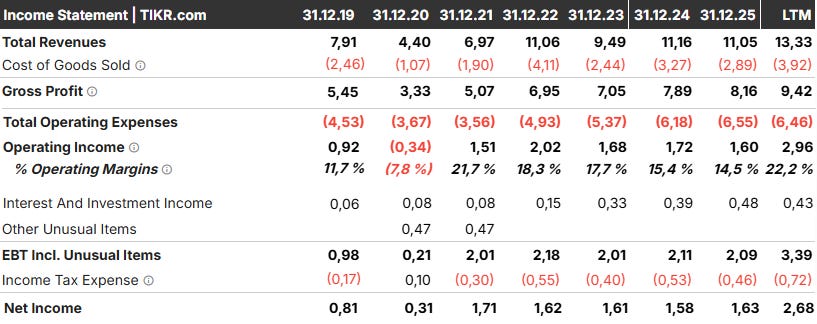
By the way, that was the only operating loss in the past decade.
On an LTM basis, which includes the strong H1 of 2026, the business trades at 4.7x EV/EBIT and 8.2x earnings.
H2 will probably come in weaker, but the full-year 2026 numbers should still be record numbers.
The balance sheet is pristine too.
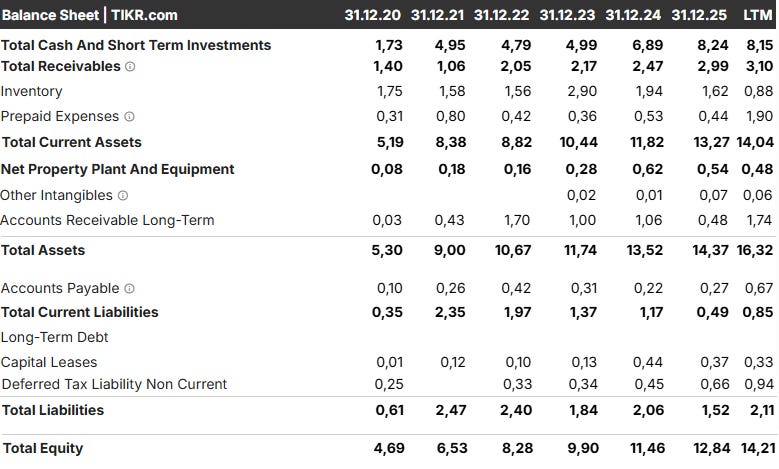
They’re sitting on $8.15m of cash and no debt, aside from a small office lease. That brings the enterprise value down to about $14m.
Notably, the equity has also grown a lot, with a CAGR of ~18% since 2016. Though in 2016 it was only $2.76m.
I also don’t think there’s much reason to worry that all this cash just sits around unused.
A growing dividend has been paid since 2022. Since 2025 the rate has been $0.02 per share quarterly, and in January 2026 the company even added a $0.10 special dividend, bringing total payouts in the first half of 2026 to about $650,000.
So here’s the profile we’re looking at: 60% or more of revenue recurring, a 79% maintenance gross margin that should soon cover the entire fixed cost base on its own, no debt, negligible capex, high returns on equity, a proven ability to grow that equity at a high rate through retained earnings, and cash that actually gets returned to shareholders.
That’s not a 4.7x EV/EBIT business.
I think the main reason for the discount is simply that it’s a small, unknown OTC stock, and you don’t see the thesis unless you spend real time with the company.
I’d also guess plenty of people see “casino” and file it under gambling stock.
There’s one more important piece here. A tailwind.
The CEO Transition
Chad Hoehne founded the company in 1994 and ran it like a technical founder.
In January 2018, he hired Randy Gilbert as CFO. Gilbert has an accounting background. He started at KPMG, spent a decade in Sarbanes-Oxley and internal audit consulting, and served as CFO of EVO Transportation in 2016 and 2017.
After eight years as the CFO, the board made him CEO at the beginning of this year. (He still keeps the CFO role.)
Hoehne, now 63, spends his time on product development. He remains the chairman and owns 1.18m shares, 25.51% of the company.
I read this change as a positive.
The founder returns to what he does best, and the numbers guy takes over the P&L.
And the actions Gilbert was involved in suggest that he is very aware of the leverage effect we just talked about, and that he runs the company in a shareholder-oriented way.
Headcount peaked at 38 at the end of 2024 and was cut to 32 during 2025, the year Gilbert prepared to take over. Which is the other way to close the gap faster, just shrinking the fixed cost base.
And three weeks into Gilbert’s tenure the board declared the company’s first special dividend.
I also think he’s well aware of what a margin improvement in the service segment could mean, and that he won’t lose sight of it.
Risks
The obvious governance weakness is that one person is now CEO and CFO at the same time. For a 32-person company, that’s defensible on cost grounds, but it does concentrate both execution and control in a single individual.
The bigger risk is this:
The whole thesis depends on the recurring revenue. And there is one odd thing.
Maintenance revenue was basically flat in the first half of 2026. $3.107m against $3.091m a year earlier, after growing 14% in 2025. If every install adds a stream, why didn’t eight installations in 2025 move the needle?
Honestly, I don’t have a clear answer. The filings don’t address it either.
It could simply have been temporarily higher churn, though churn was never really something they talked about. In the past, the reports only ever highlighted a particularly high retention rate.
It could also be that the 2025 growth was partly pushed by price increases.
Probably it’s a mix of several factors. But this definitely needs to be watched.
So the central question for Q3, Q4 and 2027 is not “does the company make money”. It’s whether the maintenance line actually keeps growing, and whether SG&A stays disciplined under the new CEO.
Final Thoughts
Table Trac is a somewhat odd, complicated little company.
But that might be a good thing for a buyer.
None of this thesis shows up on a screener. Yes, the current multiple is cheap, but that alone tells you nothing about where this business is headed.
What we have is a debt-free business with 79% maintenance margins, an 18% book value CAGR, high returns on capital, and almost 40% of the market cap sitting in cash, cash that’s actually being returned to shareholders. A moat built on switching costs. And a business dynamic that’s flipping to the positive, one that should unlock a serious amount of operating leverage.
All of that, and Mr. Market will sell it to you for 4.7x EV/EBIT and 8.2x earnings.
The recurring revenue should protect against any real losses, we saw that in 2020, and the strong balance sheet adds another layer of safety on top.
I’m happy to discuss this idea further. If you have a different take on things, or know more about why maintenance didn’t grow in H1, feel free to reach out. You can always DM me here or on X.
I’ve also opened the comments for everyone on this post. (hopefully there won’t be too many scammers…)
There are also some other smaller topics with this stock that one might look into, but I intentionally left them out here, since I don’t think they add or change anything about the investment case.
I tried to make this writeup as digestible as possible.
Disclaimer: The information provided in this newsletter is intended for informational and educational purposes only. It does not constitute financial, investment, legal, or tax advice. All analyses, opinions, and interpretations reflect my personal views at the time of publication and are provided without reference to the individual circumstances or objectives of any reader. All analyses, information, and opinions have been prepared with great care. Nevertheless, no guarantee can be given as to the accuracy, completeness, or timeliness of the information provided. Use of the content is at the user’s own risk. Investing in securities involves risk, including the possible loss of capital. Readers should conduct their own research and, if necessary, consult a qualified professional before making investment decisions.
I highlighted this one previously. It is an interesting one. https://www.benevolusinsights.com/p/5-interesting-minnesota-based-companies?utm_source=publication-search
It looks cheap. 5-6x EV/FCF.
I am concerned about the governance, the strength of the gambling end markets they are selling into, and thatt management hasn't really signaled what they are doing with the cash.
I might go the annual meeting one of these days and let you know what they say about those points.